
Yes. Lovable has a built-in backend, also called Lovable Cloud, that gives your app a database, user sign-in, file storage, realtime updates and server-side functions (Lovable’s built-in backend). You describe a feature, and Lovable builds the screens and the backend behind them, switching the backend on when a feature needs it. It’s built on Supabase and paid for with your Lovable credits. You can connect your own Supabase project instead.
What does Lovable’s built-in backend include?
The backend tools sit in the More menu of any Lovable project:
- Database. Your app’s tables, where you can view and edit records.
- Users. The people who sign up, and the sign-in methods they use.
- Storage. The files your app keeps, such as uploads.
- Edge functions. Code that runs on the server, such as webhooks and background work.
- Jobs. Scheduled tasks and their run history.
- Secrets. API keys and other private values, stored securely.
- Logs and Usage. Errors, backend activity, and what the project costs in credits.
The database, user accounts and storage come as one. Turning on any of them sets up all three, and pausing the database pauses the other two. When the backend is first switched on, Lovable places your data in the Americas, Europe or Asia Pacific, and you can’t move it afterwards.
For example, a tutor asks Lovable for a booking app where students sign up, pick a lesson time and upload homework. Lovable switches on the backend and sets up a bookings table, sign-in for students and storage for the homework files.
Does Lovable use Supabase?
Yes, in one of two ways (Lovable’s Supabase guide). The built-in backend runs on Supabase’s open-source foundation, so you get Supabase’s features without a Supabase account, managed and billed inside Lovable. Or you connect a Supabase project of your own, which Supabase bills you for and you manage in Supabase’s dashboard.
Decide early. Lovable doesn’t switch a project between the two automatically, in either direction. Moving from the built-in backend to your own Supabase means exporting the database, restoring it, and moving the files, sign-in settings and secrets by hand.
What does the backend cost?
The backend runs on the same credits you build with. Database work and storage in your live app use Cloud credits, and Free, Pro and Business plans each include 20 a month. AI calls draw first on a separate grant of 4 AI credits a month (credits and usage). Lovable marks that monthly grant as temporary. If your workspace runs out of credits, apps that rely on the backend pause until you add more.
What should you check before you build on it?
Two settings, both under Account settings > Preferences > Agent permissions. By default, Lovable can add, change and delete data in your tables without asking, so switch Change data to Ask each time once real people use your app. Changes that could break your live app, like renaming a column, are set to Never allow by default.
Removing the backend later permanently deletes the database, its backups, your users' accounts and every stored file. Export what you need first.
On Lovable, each app’s backend is set up one project at a time, inside Lovable’s infrastructure, and paid for in credits for as long as it runs.
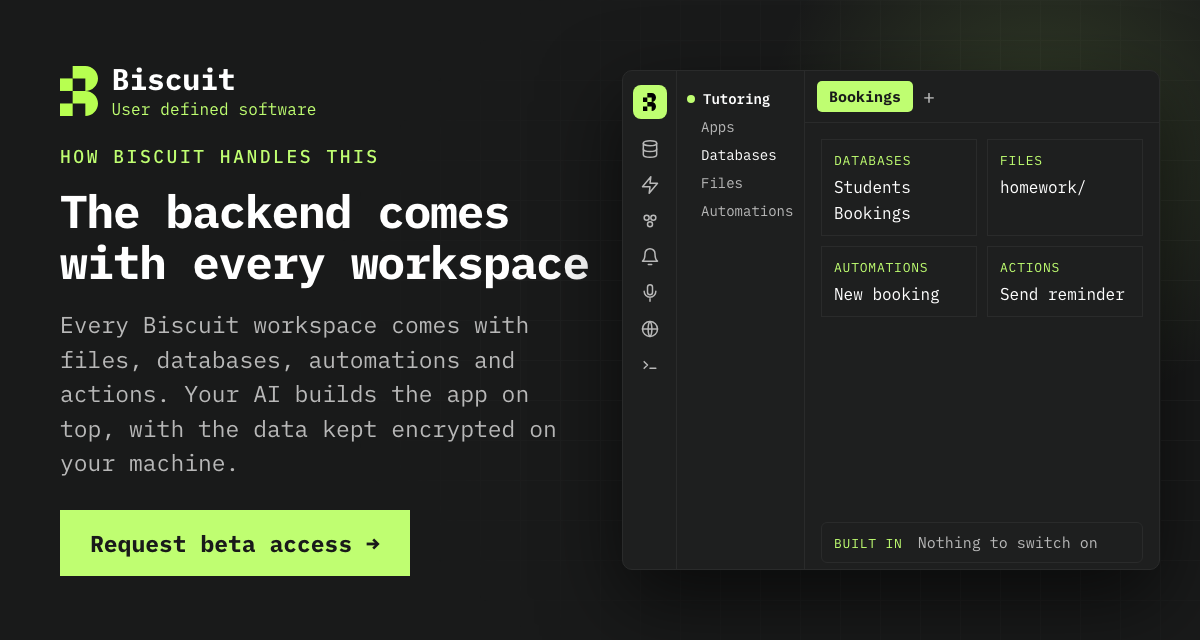
Request beta access to Biscuit
References
- Built-in backend, Lovable Documentation, read 27 October 2026
- Supabase integration, Lovable Documentation, read 27 October 2026
- Credits and usage, Lovable Documentation, read 27 October 2026
All links checked and active as of 27 October 2026.