A vendor has pitched “agentic AI” to you, and the last proposal on your desk said “AI agent”. Are they the same thing, and does the difference change what you should buy?
An AI agent is one worker. It’s given a goal, and it chooses its own steps to reach it, using the tools it has been given. Agentic AI is the arrangement those workers sit in, with several agents, fixed steps between them, and people at the checkpoints, all aimed at a bigger outcome. One is part of the other, so the useful question is how many agents your job needs, and where the fixed steps and the people go.
We build both single agents and chains of them at Idea Labz. This guide covers what each term means, how they differ in practice, a system of agents we built for a design firm, and three questions that tell you what size of build your job needs.
- AI agents vs agentic AI at a glance
- What is an AI agent?
- What is agentic AI?
- How are AI agents and agentic AI different?
- What agentic AI looks like in practice: a mood board pipeline
- When does a team of agents earn its keep?
- What to ask a vendor who says “agentic”
- How many agents does your job need?
- Frequently asked questions
- What to do next
AI agents vs agentic AI at a glance
Generative AI sits in the first column because both agents and agentic systems are built on it.
| Generative AI | AI agent | Agentic AI (a system of agents) | |
|---|---|---|---|
| What it is | A model that writes text, images or code when you ask | One system that pursues a goal by choosing its own next step | Several agents and fixed steps, coordinated towards a larger goal |
| How many agents | None | One | Two or more, run in a set order or by an orchestrating agent |
| Who decides the next step | You, one prompt at a time | The model, within the limits you set | Each agent within its stage, and the order you set between stages |
| What it can act on | Nothing outside the conversation, unless given tools | The tools it’s given, such as a calendar, a database or email | Each agent’s own tools, plus the hand-offs between agents |
| What it keeps between steps | The current conversation | Its working memory for the task | A shared record passed from stage to stage |
| Where it can go wrong | A wrong or invented answer | A wrong step or a wrong tool call | Every hand-off, plus agents working from each other’s mistakes |
| Example | Drafting a reply you then edit | Moving a customer’s service appointment to a new slot | Reporting on a mood board against a client’s brief, then running again on the client’s feedback |
| Best for | One-off drafting and answering | One job whose path changes with what it finds | A job that splits into stages needing different instructions, permissions or checks |
What is an AI agent?
An AI agent is software that’s given a goal, uses a language model to decide its own next step, acts through tools, checks what came back, and repeats until the goal is met or it needs a person. Choosing its own next step is what separates an agent from a script.
For example, when a customer asks to move a service appointment, an agent can check the calendar, the technician’s other jobs that day and the parts in stock, offer two new slots, and book the one the customer picks. It asks a person only when a late-change fee applies. That’s one agent, with one set of instructions and a handful of tools, doing one job.
We cover the parts of an agent, from the model and its instructions to its tools, memory and guardrails, and a full run from start to finish, in our guide to what AI agents are and how they work.
What is agentic AI?
Agentic AI is a system built from several agents, with fixed steps and people around them, working towards a goal that’s bigger than any one agent’s job. Each agent does one part of the work and hands its output to the next, and the design of the system decides the order, the hand-offs and the checks.
For example, on reporting work we split research, analysis, verification and testing into separate stages. Each stage’s output can then be checked before the next one uses it.
You’ll also hear “agentic” used more loosely, for a single agent that acts on its own or for almost any AI product. When someone uses the word, ask what they mean by it. If they mean several agents, the questions further down this page apply. If they mean one agent, our guide to AI agents covers what to look for.
How are AI agents and agentic AI different?
The differences that change what you build are about structure. The same model can run inside a single agent or inside every agent of a larger system, so the model alone doesn’t make a system agentic.
Who coordinates the work
A single agent coordinates itself. A system of agents needs something to decide which agent runs next. That’s either a fixed sequence a developer wrote, or an orchestrating agent that splits the work as it goes. A fixed sequence is easier to test, and an orchestrator is more flexible.
Who sets the sub-goals
An agent works towards the goal it’s given. In a system with an orchestrator, the orchestrator may break the goal into sub-tasks while it runs, so nobody wrote those sub-tasks down in advance. They have to be logged before anyone can review them.
What carries over between steps
A single agent holds its working memory for the length of one task. A system of agents needs shared records that every stage reads and writes, such as a project file, a brief or a database table. Each agent only knows what the previous stage wrote down, so the shared record has to carry everything the next stage needs.
Where it can go wrong
Every hand-off is another place for an error to enter, and a later agent can build on an earlier agent’s mistake without noticing it. Agents can also work at cross purposes when two of them act on the same record. And each agent with its own tools is one more thing someone could try to misuse, so each one needs its own permissions.
What it costs to run
Each agent in a chain makes its own model calls, so a five-stage system makes at least five calls for every job, and usually more. More agents mean more cost and a slower result, a trade Anthropic also points out in its guide to building agents. It’s worth making only when the job needs what the extra stages give you.
What agentic AI looks like in practice: a mood board pipeline
The clearest way to see the difference is a job that came to us as a mandate for one agent and was built as several. We built this one for a design firm, around the way a high-end studio for graphic, product and physical product design runs its projects, and it’s now running in production.
The firm gave us a mandate for an agent to handle its internal process. We put that into place as separate workflows, each with its own agent, and the firm’s designers stay in the loop at every stage. The designers do the creative work, and the agents do the reading, checking and preparing around it. A project runs like this:
- Discovery. The firm’s team runs discovery calls with the client. The calls are transcribed and saved, along with the client’s mandate and requirements.
- Mood board. The designers research the project and build a mood board.
- Mood board report. An agent reads the images on the board, reports what has been captured across the whole board, and correlates it with the discovery call and the requirements.
- Design direction. The designers review that report, decide what to keep and what to change, and set the direction for the work.
- The next agent. The report and the designers’ decisions become the input for the next stage, where another agent picks them up and works from them, again for the designers to review.
- Design. The designers create the work, and the team reviews it before it goes to the client.
- Client review. The work goes to the client on the firm’s client-facing platform.
- Feedback. The client leaves feedback on the platform. The feedback starts the agents again, and the designers take the next round from there.
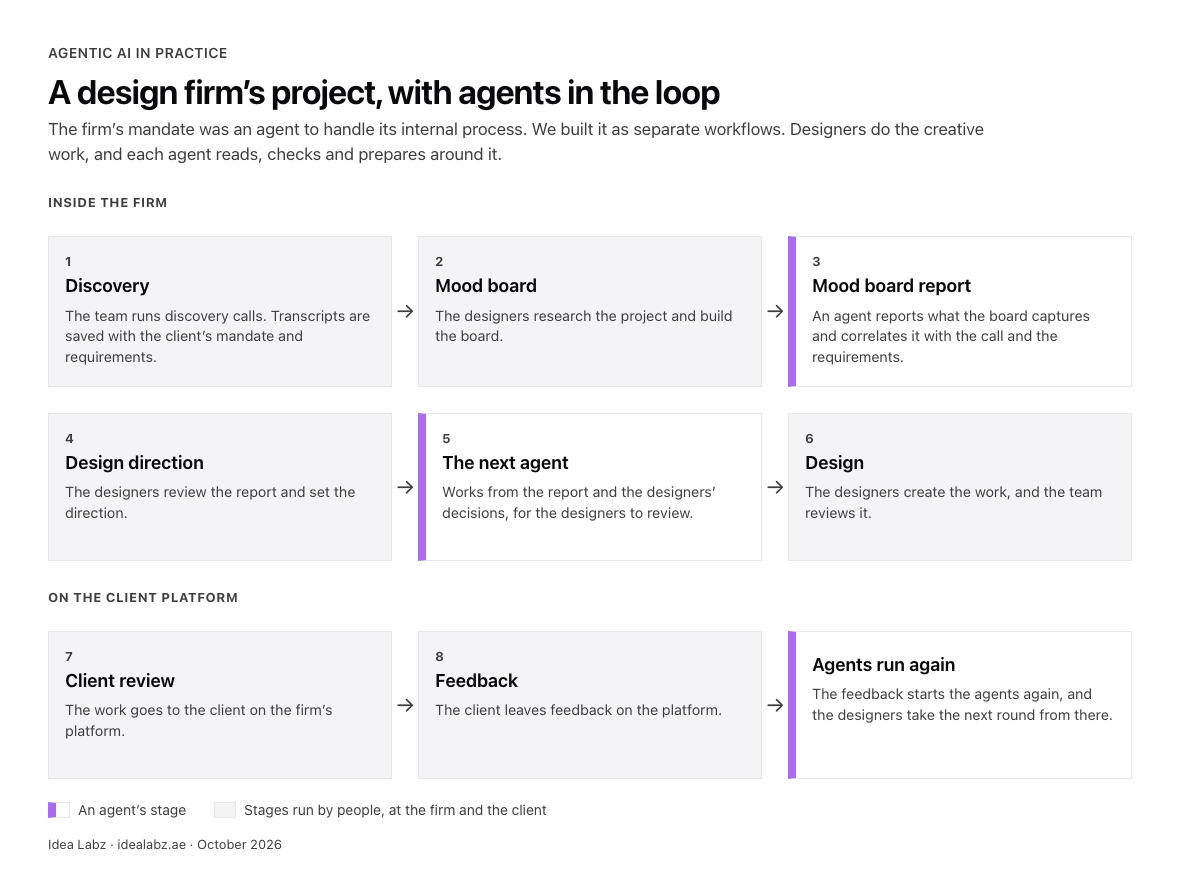
Designers do the creative work; each agent’s stage is marked in purple.
Why not one agent for the whole process? One set of instructions would have to hold the discovery call, the requirements, every image on the board, the designers’ decisions, the project’s history and each round of client feedback, and it would be hard to tell which part went wrong when an output missed. Split into stages, each agent has one job and one set of inputs, and you can read what each stage produced before the next one starts. That’s agentic AI as this page uses the term, built from ordinary agents, with the order of the stages fixed by design.
When does a team of agents earn its keep?
A team of agents earns its keep when one job splits into parts that need different instructions, different permissions, or a check that’s independent of the work it checks. A task that one set of instructions can cover doesn’t need a team, so start with one agent and split only when you have a reason.
These are the signs that a job does split:
- The stages need different context. Reading images and comparing them with a discovery call are different jobs, as the mood board chain shows.
- The stages need different permissions. An agent that drafts shouldn’t be the one that sends, and one that reads customer records shouldn’t also write to the website.
- The work needs an independent check. A reviewer that didn’t write the draft catches more than the writer checking itself.
- The job is too big for one run. A long research task or a large codebase can outgrow what one agent can hold at once.
We run a system like this for our own software work, with separate model roles for planning, supervising and building, and a person approving at every gate. We describe how it works in why three model roles and a human one.
What to ask a vendor who says “agentic”
Four questions turn “agentic” into something you can compare and test:
- How many agents are there, and what does each one do? A good answer names each agent and its single job.
- Who decides the next step, the model or your code? Fixed steps are cheaper and easier to test, and model-chosen steps are more flexible. You should know which parts are which.
- What can each agent do without a person approving it? Look for a written list, per agent, of what it does alone, what waits for approval, and what it may never do.
- What’s logged, and who can read it? Every agent’s inputs, tool calls and outputs should be recorded somewhere your team can open.
The same four questions apply to us. For the wider list of what to ask any agency before signing, see our 10 questions to ask an AI automation agency.
How many agents does your job need?
Three questions settle it, and each one points at a different build.
- Are the steps the same every time? Then a workflow with an AI step is enough. For example, logging every booking from your website form in the calendar and sending the same confirmation doesn’t need an agent at all. Our step-by-step guide to how AI automation works shows a workflow of that kind.
- Does one set of instructions and tools cover the whole job, with the path changing based on what it finds? Then one agent is the right size. Moving a customer’s appointment, where the next step depends on the calendar, the technician and the parts, is a one-agent job.
- Does the job split into stages that need different context, permissions or an independent check? Then several agents, in a fixed order, with people at every checkpoint. The mood board pipeline is that kind of job.
If you’re unsure, start with one agent on the narrowest version of the task, and split it into stages only when you can name the stage that keeps going wrong.